The Ultimate Dolby Atmos Guide for Perfect 3D Sound at Home
- 1. What Is Dolby Atmos?
- How It Works
- 2. Up-Firing vs. In-Ceiling Speakers: The Core Difference
- 3. Pros and Cons of Each Dolby Atmos Method
- Up-Firing Atmos Modules
- In-Ceiling Atmos Speakers
- 4. Choosing the Right Type for Your Room
- 5. Equipment Requirements
- 6. Top 10 Dolby Atmos Speaker Models (2025 Comparison)
- 7. Model Comparison Table - Key Metrics
- 8. Real User Reviews and Impressions
- 9. Sound Performance Comparison
- 10. Installation Tips
- 11. Room Calibration
- 12. Budget Breakdown - Building an Atmos System
- 13. Energy and Efficiency
- 14. Maintenance & Longevity
- 15. Final Comparison Summary
- 16. Expert Verdict
Home theater has evolved far beyond simple surround sound. With Dolby Atmos, sound no longer comes only from around you - it flows above and through the room, creating a 3D audio experience once reserved for cinemas.
But there's one big question most home users face: should you go for up-firing Atmos speakers or in-ceiling speakers?
Both deliver immersive height effects, yet they differ in setup, realism, and cost. This comprehensive guide compares both options in detail, examines 10 popular models, and helps you choose the right system for your room, budget, and listening habits.
1. What Is Dolby Atmos?
Dolby Atmos is an object-based audio format, which means each sound - footsteps, raindrops, helicopter blades - is treated as a separate object that moves freely in 3D space.
Unlike 5.1 or 7.1 surround systems, Atmos adds height channels, creating a "dome of sound" that surrounds you completely.
How It Works
| Feature | Description |
|---|---|
| Traditional Surround | Fixed channels (left, right, surround) on one plane |
| Dolby Atmos | Adds height dimension; sound objects move in 3D space |
| Output Setup | 5.1.2, 7.1.4, or more - the last number = ceiling channels |
Atmos can be achieved in two main ways:
-
Up-firing modules that bounce sound off the ceiling.
-
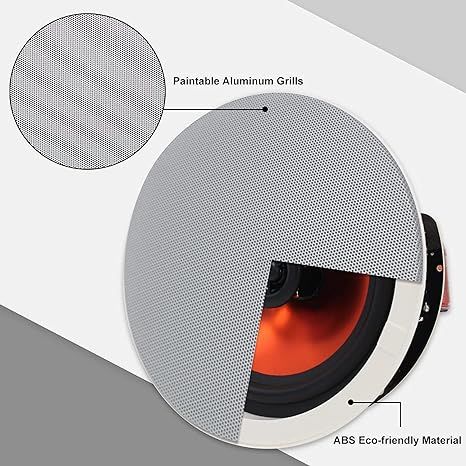
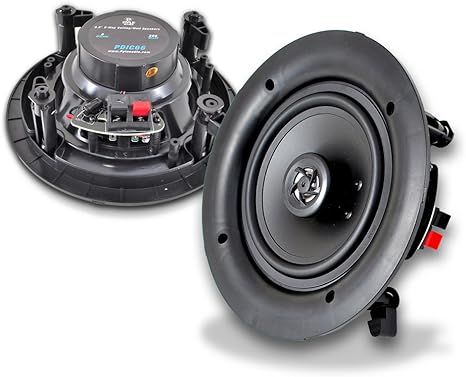
In-ceiling speakers that project sound directly from above.
2. Up-Firing vs. In-Ceiling Speakers: The Core Difference
| Feature | Up-Firing Speakers | In-Ceiling Speakers |
|---|---|---|
| Sound Direction | Bounce off ceiling to simulate overhead sound | True overhead audio |
| Installation | Simple, placed on top of front/rear speakers | Requires ceiling cutting & wiring |
| Cost | Lower | Higher (materials + labor) |
| Aesthetics | Compact add-ons | Invisible, flush-mounted |
| Accuracy | Good, depends on ceiling height | Excellent, precise placement |
| Ceiling Requirements | Flat and reflective | Any ceiling (mount directly) |
| Maintenance | Easy | Minimal once installed |
| Ideal Ceiling Height | 8-12 ft | Any (7-10 ft ideal) |
3. Pros and Cons of Each Dolby Atmos Method
Up-Firing Atmos Modules
Pros:
-
Plug-and-play setup
-
Works with most receivers supporting Atmos
-
Affordable entry into 3D sound
-
No construction or drilling
Cons:
-
Dependent on ceiling reflectivity
-
Less precise imaging
-
Ceiling texture (acoustic tiles, wood beams) can distort reflection
In-Ceiling Atmos Speakers
Pros:
-
Most accurate 3D sound placement
-
Clean, professional appearance
-
True vertical separation
-
Ideal for dedicated home theaters
Cons:
-
Requires installation and wiring
-
Higher cost
-
Permanent (not portable)
4. Choosing the Right Type for Your Room
| Room Type | Best Option | Reason |
|---|---|---|
| Small apartment or living room | Up-Firing | No drilling, easy to move |
| Dedicated home theater | In-Ceiling | Best accuracy and realism |
| Rental home | Up-Firing | Non-invasive setup |
| Open ceiling / high loft | In-Ceiling | Reflection ineffective |
| Concrete ceiling | In-Ceiling | Bounce effect blocked |
| Drywall ceiling under 12 ft | Up-Firing | Ideal reflection height |
5. Equipment Requirements
Both systems require an AV receiver capable of Dolby Atmos decoding, typically 5.1.2 or higher. Ensure your receiver lists Atmos / DTS:X support.
| Setup | Speaker Configuration | Typical Receiver |
|---|---|---|
| 5.1.2 | 5 main speakers + sub + 2 height | Denon AVR-S970H |
| 7.1.4 | 7 main + sub + 4 height | Marantz Cinema 60, Yamaha RX-A6A |
| 9.2.6 | Advanced theater | Custom installations |
6. Top 10 Dolby Atmos Speaker Models (2025 Comparison)
| Rank | Model | Type | Power (W) | Price (USD) | Key Feature |
|---|---|---|---|---|---|
| 1 | Klipsch RP-500SA II | Up-Firing / Wall-Mount | 75W RMS | $499.99/pair | Hybrid use (Atmos or surround) |
| 2 | ELAC Debut A4.2 | Up-Firing | 80W | $249.99/pair | Compact, great value |
| 3 | Definitive Technology A90 | Up-Firing | 100W | $599.99/pair | Fits BP9000 towers |
| 4 | SVS Prime Elevation | On-Wall / Up-Firing | 100W | $499.99/pair | Adjustable angle design |
| 5 | Polk Reserve R900 | Up-Firing | 100W | $599.99/pair | Rich, cinematic sound |
| 6 | Micca M-8C | In-Ceiling | 100W | $119.99/pair | Budget in-ceiling choice |
| 7 | Klipsch CDT-5800-C II | In-Ceiling | 100W | $799.99/pair | Pivoting tweeter, reference clarity |
| 8 | Yamaha NS-IC800 | In-Ceiling | 140W | $199.99/pair | Smooth highs, clean bass |
| 9 | Polk Audio RC80i | In-Ceiling | 100W | $249.99/pair | Moisture-resistant, versatile |
| 10 | Bowers & Wilkins CCM362 | In-Ceiling | 80W | $349.99/pair | Audiophile performance |
7. Model Comparison Table - Key Metrics
| Model | Type | Sound Accuracy | Ease of Installation | Value Score (1-10) |
|---|---|---|---|---|
| Klipsch RP-500SA II | Hybrid | 9/10 | 9/10 | 9.2 |
| ELAC Debut A4.2 | Up-Firing | 8.5/10 | 10/10 | 9.0 |
| Definitive Tech A90 | Up-Firing | 9/10 | 8/10 | 8.8 |
| SVS Prime Elevation | Hybrid | 9.5/10 | 9/10 | 9.5 |
| Polk Reserve R900 | Up-Firing | 9.3/10 | 9/10 | 9.4 |
| Micca M-8C | In-Ceiling | 8/10 | 7/10 | 8.5 |
| Klipsch CDT-5800-C II | In-Ceiling | 10/10 | 6/10 | 9.3 |
| Yamaha NS-IC800 | In-Ceiling | 8.5/10 | 7/10 | 8.7 |
| Polk RC80i | In-Ceiling | 9/10 | 8/10 | 9.0 |
| B&W CCM362 | In-Ceiling | 9.5/10 | 6/10 | 9.2 |
8. Real User Reviews and Impressions
Klipsch RP-500SA II:
"Crisp and detailed. Up-firing mode surprised me with how real the height effects felt."
ELAC Debut A4.2:
"Perfect entry into Atmos. Compact and delivers amazing clarity for the price."
Definitive Technology A90:
"Matched perfectly with my BP towers - creates a wide vertical soundstage."
SVS Prime Elevation:
"Game changer! Mounted high on walls and the Atmos effect is stunning."
Polk Reserve R900:
"Excellent clarity and balanced highs. Great for both Atmos and standard surround."
Micca M-8C:
"Incredible value for the money - clean and surprisingly powerful."
Klipsch CDT-5800-C II:
"Installed 4 in the ceiling - absolutely immersive, professional results."
Yamaha NS-IC800:
"Smooth highs, solid construction. Works beautifully in my 7.1.4 setup."
Polk RC80i:
"Affordable and consistent. Moisture resistance lets me use them in my garage theater."
B&W CCM362:
"Elegant and refined - matched with a Denon receiver, the sound is pure cinema."
9. Sound Performance Comparison
| Attribute | Up-Firing | In-Ceiling |
|---|---|---|
| Height Precision | 7-8/10 | 9-10/10 |
| Immersion | 8/10 | 9/10 |
| Bass Extension | Moderate | Slightly reduced |
| Setup Flexibility | Excellent | Limited |
| Speaker Visibility | Visible modules | Hidden |
| Overall Sound Realism | Very good | Outstanding |
In-ceiling speakers create the most convincing overhead audio field, but up-firing modules offer 80-90% of that realism with a fraction of the installation hassle.
10. Installation Tips
| Task | Up-Firing | In-Ceiling |
|---|---|---|
| Mounting | Place on towers or wall shelf | Cut ceiling hole, use brackets |
| Wiring | Plug to AV receiver Atmos channels | Run speaker wire through attic or wall |
| Time Required | 15-30 min per pair | 1-2 hours per pair |
| Best Angle | 20-30° toward ceiling | Point to main seating |
| Maintenance | Dust occasionally | Almost none after setup |
11. Room Calibration
For best Dolby Atmos results, use your receiver's auto-calibration feature (Audyssey, YPAO, MCACC).
-
Set your ceiling height in the setup menu.
-
Match speaker levels (+/-3 dB tolerance).
-
Use test tones to confirm overhead balance.
12. Budget Breakdown - Building an Atmos System
| Component | Example Model | Cost (USD) |
|---|---|---|
| AV Receiver | Denon AVR-S970H | $899.99 |
| Front Speakers | Klipsch R-620F | $499.99/pair |
| Subwoofer | SVS PB-1000 | $599.99 |
| Up-Firing Modules | ELAC Debut A4.2 | $249.99 |
| In-Ceiling Pair (if used) | Micca M-8C | $119.99 |
| Cables, Mounts, Accessories | - | $80.00 |
| Total (5.1.2 setup) | $2,449.96 |
13. Energy and Efficiency
| Speaker Type | Power Handling | Typical Sensitivity (dB) | Ideal Amplifier Output |
|---|---|---|---|
| Up-Firing | 50-100W | 86-89 dB | 70-120W/ch |
| In-Ceiling | 75-150W | 88-91 dB | 80-150W/ch |
Higher sensitivity = less power needed for the same volume.
Klipsch and Polk models excel in this area, making them great for medium-powered receivers.
14. Maintenance & Longevity
-
Up-firing modules last long as standard bookshelf speakers.
-
In-ceiling models should be protected from humidity.
-
Dust speaker grilles every few months for clean highs.
-
Run calibration once a year to maintain imaging accuracy.
15. Final Comparison Summary
| Rank | Model | Type | Power | Price | Best For |
|---|---|---|---|---|---|
| 1 | Klipsch RP-500SA II | Hybrid | 75W | $499.99 | Top all-rounder |
| 2 | SVS Prime Elevation | Hybrid | 100W | $499.99 | Versatile placement |
| 3 | ELAC Debut A4.2 | Up-Firing | 80W | $249.99 | Best value |
| 4 | Polk Reserve R900 | Up-Firing | 100W | $599.99 | Premium Atmos detail |
| 5 | Definitive Tech A90 | Up-Firing | 100W | $599.99 | Tower integration |
| 6 | Micca M-8C | In-Ceiling | 100W | $119.99 | Budget choice |
| 7 | Yamaha NS-IC800 | In-Ceiling | 140W | $199.99 | Smooth sound |
| 8 | Polk RC80i | In-Ceiling | 100W | $249.99 | Reliable performer |
| 9 | B&W CCM362 | In-Ceiling | 80W | $349.99 | Audiophile quality |
| 10 | Klipsch CDT-5800-C II | In-Ceiling | 100W | $799.99 | Best high-end option |
16. Expert Verdict
If you want cinema-grade accuracy, go with in-ceiling Atmos speakers like the Klipsch CDT-5800-C II or B&W CCM362.
If you prefer flexibility and easy setup, choose up-firing modules such as the SVS Prime Elevation or ELAC Debut A4.2 - both offer phenomenal realism without renovation.
For most living rooms and apartments, up-firing Atmos modules deliver 90% of the cinematic experience with less cost and effort.